
5 Best Cat Carriers for Vet Visits, Large Cats and Flying
Five cat carriers compared for vet visits, large cats, flying, long trips and short outings, plus how to choose one and get your cat used to it.
 By William Foster
Updated November 23, 2026

The best cat carrier for most cats is a sturdy, easy-to-clean carrier that opens at the top as well as the front. International Cat Care says a top-opening carrier is much easier to use because your cat can be gently lifted in or out, and that a carrier should be easy to clean and not so large that your cat falls about in it. For flying, a soft carrier that fits under the seat makes more sense, but your airline’s rules decide what is allowed.
Below are five carriers for different jobs: vet visits, large cats and car trips, flying, long trips and short outings. Specs come from each product’s Amazon listing, so measure your cat and compare the numbers before you buy. If you are setting up for a new cat, a carrier belongs on the new kitten supply checklist from day one.
Our Top Picks
- For vet visits: Amazon Basics 2-Door Top-Load Carrier (hard)
- For large cats and car trips: Catit Cabrio Cat Carrier (hard)
- For flying in the cabin: Sherpa Original Deluxe, Medium (soft)
- For long trips: Necoichi Portable Ultra Light Cat Carrier (pop-up)
- For short outings: Cawypety Bubble Backpack (backpack)
The picks are ordered by how well they fit everyday use, starting with vet trips, which is the journey most cats make most often. None of these listings claims crash certification, so treat any carrier as a way to keep your cat contained and secured, not as a safety device.
| Carrier | Type | Openings | Size (listing) | Weight limit (listing) | Best for |
|---|---|---|---|---|---|
| Amazon Basics 2-Door Top-Load | Hard plastic | Top and front | 22.8 x 15 x 13 in | 12 to 20 lb (reference only) | Vet visits |
| Catit Cabrio | Hard plastic | 360° access | 20 x 13 x 13.75 in | 25 lb | Large cats, car trips |
| Sherpa Original Deluxe (Medium) | Soft | Top and side | 17 x 11 x 10.5 in | 16 lb | Flying in the cabin |
| Necoichi Portable Ultra Light | Pop-up mesh cage | Front and side | 31.8 x 20 x 20 in | Not listed | Long trips, hotel stays |
| Cawypety Bubble Backpack | Backpack | Side | 13.4 x 11 x 16.5 in | Under 15 lb | Short outings |
Pros
- Top and front doors
- Plastic shell wipes clean
- Vents on sides, top and back
Cons
- Screws hold the halves together
- 13 in tall, tight for tall cats

Pros
- Listed for cats up to 25 lb
- Seatbelt-secured design
- Skid-resistant floor, outside dish access
Cons
- Heaviest pick at 6.7 lb
- 20 in long, measure long cats

Pros
- Frame compresses to fit under seats
- Top and side entry, locking zippers
- Washable liner, waterproof base
Cons
- 10.5 in tall, cat lies down
- 16 lb limit; check your airline
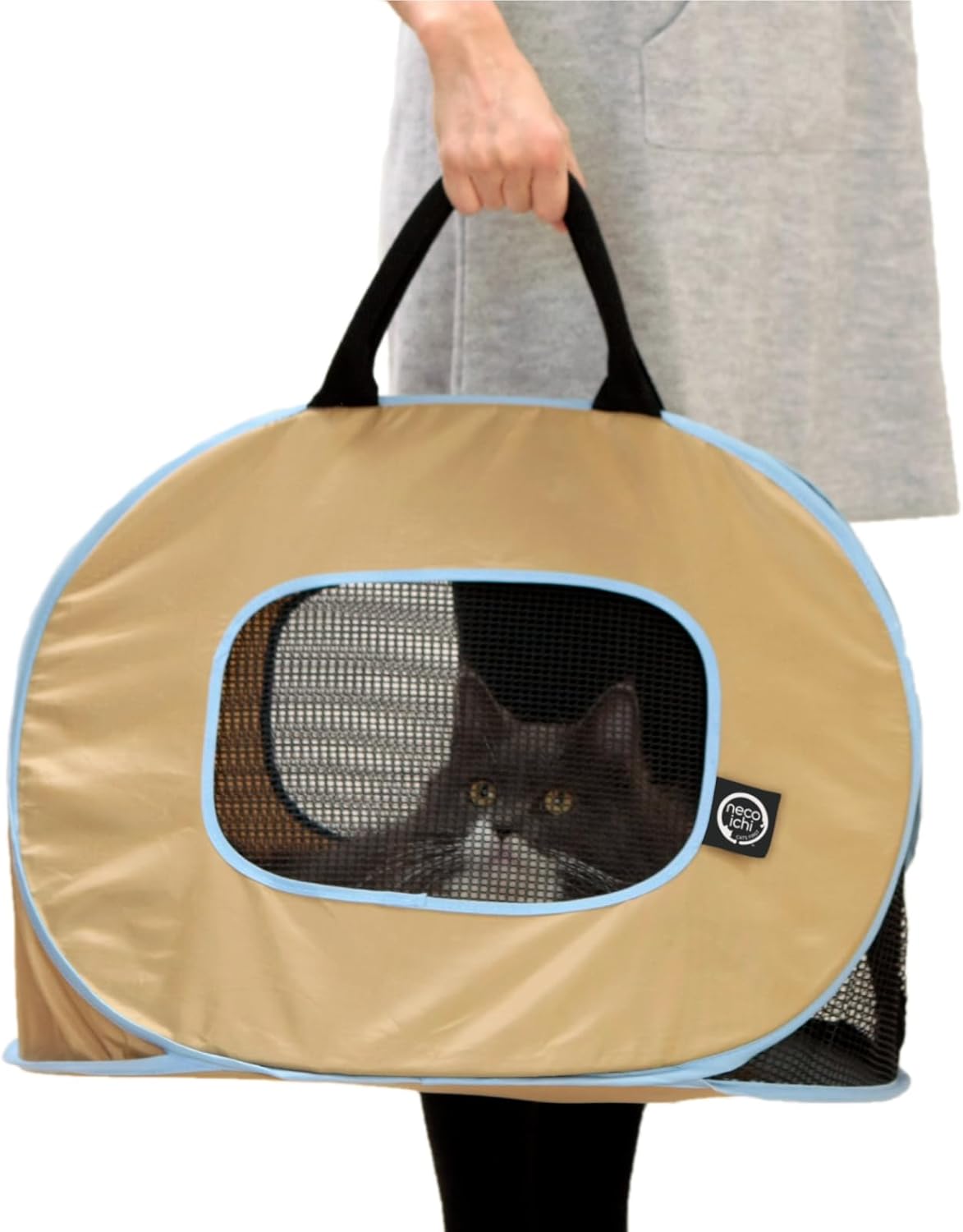
Pros
- Roomy 31.8 x 20 x 20 in cage
- Folds to a flat circle
- Fleece mat and storage bag included
Cons
- Too big for vet-trip carrying
- Litter box sold separately

Pros
- Hands-free backpack
- Bubble window, vents and mesh
- Built-in safety leash
Cons
- For cats under 15 lb
- Side entry only, no top opening
For vet visits: Amazon Basics 2-Door Top-Load Carrier
This hard plastic carrier has the layout vets and cat welfare groups describe: a top door for lifting your cat in and out, plus a front door for cats that walk in on their own. The plastic shell is simple to wipe down after a messy trip, and the listing says to pick the size by your pet’s height and length, with weight as a reference only.
- Two doors, front and top entry; the top door swings open to the left or right (Amazon listing)
- Plastic body with steel wire doors and spring-loaded latches for one-handed opening
- Ventilation on the sides, top and back; top carry handle
- 22.8 x 15 x 13 in; listed for a cat or medium dog of 12 to 20 lb; about 4.5 lb empty
Consider: screws hold the top and bottom halves together, so the top does not lift off as quickly as a clip-on lid. At 13 in tall it may feel tight for a tall cat, and a rigid shell takes more storage space than a soft or folding carrier.
For large cats and car trips: Catit Cabrio Cat Carrier
The Cabrio is made for cats and carries the highest listed weight limit here, 25 lb, which makes it the pick for a big, heavy cat. The listing says it is designed to be secured with a regular car seatbelt and has a skid-resistant floor, both useful on car trips. A dish can be reached from outside, so you can offer water without opening the door.
- “360° accessible design” with a single-hand locking mechanism (Amazon listing)
- Designed to be secured with a conventional seatbelt; skid-resistant floor
- Molded handle plus shoulder strap; removable dish with outside access
- 20 x 13 x 13.75 in; for cats up to 13.75 in tall and 25 lb; 6.7 lb empty
Consider: it is the heaviest carrier here before your cat goes in, and at 20 in long it is shorter than the Amazon Basics. The listing calls it ideal for small to medium cats, so measure a long cat’s body length and height against the interior before you rely on the 25 lb figure.
For flying in the cabin: Sherpa Original Deluxe Travel Pet Carrier (Medium)
This soft carrier suits cats that fly with you in the cabin, and owners who want a lighter carrier for the car or vet. The listing says a spring wire frame lets the back be pushed down several inches to fit under airplane seats, and that the carrier is airline approved and part of Sherpa’s Guaranteed On Board program. That is the seller’s claim, so still check your airline’s rules.
- Top and side entry with locking zippers; mesh panels for ventilation (Amazon listing)
- Padded handle, detachable shoulder strap and a luggage strap that doubles as a seatbelt pass-through
- Waterproof base with a removable, machine-washable faux lambskin liner
- 17 x 11 x 10.5 in; fits pets up to 16 lb; 3 lb empty
Consider: at 10.5 in tall, most cats will need to lie down inside, and the limit is 16 lb. Soft sides are harder to clean than plastic, which International Cat Care prefers, so keep a spare liner for accidents.
For long trips: Necoichi Portable Ultra Light Cat Carrier
For a move, a long drive or a hotel stay, a roomy cage is often more useful than a small carrier. VCA advises that a cat on a long trip travel in a large crate with enough space for a bed, toys, a spill-resistant water bowl and a litter box. This pop-up cage is the largest pick here, and the listing says it fits two cats with a travel litter box, so it also suits a big cat that needs room to stretch.
- Pop-open, fully collapsible nylon cage; folds to a 14 x 14 x 4.5 in circle (Amazon listing)
- Assembled 31.8 x 20 x 20 in; front entrance 13.7 x 13.7 in, side entrance 24.4 x 11.8 in
- Roll-up mesh panels and zipper locks
- Removable, double-sided waterproof fleece mat and storage bag included; about 11.7 oz
Consider: it is a soft mesh cage, not a rigid carrier, and too large to carry like a vet-visit carrier. The travel litter box is sold separately, and the listing gives no weight limit.
For short outings: Cawypety Cat Backpack Carrier with Bubble Window
A backpack frees both hands, which helps on a short walk, a trip on foot or a stroll with a calm cat that likes to look around. This one has a clear bubble window on the front, air vents and mesh panels, and a built-in safety leash to clip to your cat’s harness. If your cat is learning to go outside, pair it with a well-fitted cat harness.
- Transparent bubble window; air vents and mesh panels; side entry (Amazon listing)
- 600D oxford cloth and nylon mesh; folds for storage
- Built-in safety leash; double-sided plush cushion that comes out for washing
- 13.4 x 11 x 16.5 in; for cats under 15 lb; about 2.2 lb
Consider: the space is tall and narrow, so there is less room to stretch out than in a hard carrier, and the limit is under 15 lb. It loads from the side only, so you cannot lift your cat out from the top at the vet. A clear window in full sun can warm up, so keep an eye on your cat.
How to Choose a Cat Carrier
- A top opening, ideally a removable top. VCA veterinarians recommend a carrier that opens from the top or front, and ideally one where the top half comes off so the vet can reach your cat while it still feels safe in the bottom half.
- The right size, not the biggest. Your cat should be able to lie down and change position. Very large carriers let a cat slide around, so save the roomy cages for long trips and overnight stays.
- Easy to clean. Cats can get carsick or have accidents on the way. Plastic wipes clean fastest; with soft carriers, look for a waterproof base and a washable liner.
- Sturdy, not cardboard. International Cat Care notes that cardboard is no match for a determined cat. Choose a carrier with secure latches or locking zippers.
- Ventilation and a way to secure it. Look for vents or mesh on several sides. In the car, belt the carrier to a seat or place it in a footwell so it cannot move.
- Your cat’s size. Measure body length and height and compare with the listing. Weight limits are a guide, and long or tall cats may need a bigger model even within the weight range.
How to Get Your Cat Used to the Carrier
International Cat Care suggests the carrier should be part of the furniture at home, not something that appears only when a vet visit is coming. Leave it out at home with the door open, put a blanket your cat already sleeps on inside, and offer treats, meals or toys in or near it.
- Leave it out every day. Put the carrier in a quiet spot with soft bedding so your cat can nap in it on its own terms.
- Reward going in. Drop treats inside and feed meals near the carrier, then gradually move the bowl inside.
- Close the door briefly. Once your cat is relaxed inside, close the door for short periods, praise and let them out, so a closed door does not always mean a car ride.
- Take short practice drives. Short rides that end back at home, not at the clinic, help your cat learn that the car is not always bad news.
- Add familiar smells. Rubbing a soft cloth on your cat’s face and then around the carrier corners spreads a familiar scent.
If your cat still panics, keep the carrier close but out of sight, wrap your cat in a thick, familiar towel and place it inside quickly but gently. A top-opening carrier makes this much easier. On the trip, cover the carrier with a towel and carry it from underneath instead of swinging it by the handle. If travel stress is severe, ask your veterinarian about options that can help your cat stay calmer during visits.
Flying With a Cat
Airline pet rules change and differ from one carrier to the next, so check your airline’s current pet policy before you book. Look up the under-seat size limit, whether a soft or hard carrier is required, how many pets are allowed in the cabin and what paperwork the airline asks for. “Airline approved” on a product listing is the seller’s claim, not a promise that your airline will accept it on your flight.
A soft carrier that compresses to fit under the seat, like the Sherpa above, is the usual choice for cabin travel. Practice with it at home for a few weeks first, and pack a spare liner and a familiar-smelling blanket in case of accidents. Before any trip, it also helps to know the common signs a cat is unwell before you go.
Frequently Asked Questions
What is the best type of cat carrier for vet visits?
A sturdy, easy-to-clean carrier that opens at the top as well as the front. International Cat Care and VCA both favor a top opening because the cat can be lifted in and out gently, and VCA adds that a top half that comes off lets the vet reach your cat while it stays in the base.
Should a cat carrier be big or small?
Big enough for your cat to lie down comfortably and change position, but not oversized. International Cat Care warns against a carrier so large that the cat falls about in it. Choose by your cat’s length and height first, then check the listed weight limit.
Are soft or hard cat carriers better?
Each has a job. Hard plastic carriers are easier to wipe clean, which matches International Cat Care’s preference for plastic or plastic-coated carriers. Soft carriers are lighter and easier to fit under an airplane seat, but they are harder to clean if your cat has an accident.
Is a cat backpack a good carrier?
A backpack suits a calm, smaller cat on short outings when you want your hands free. It is not the easiest choice for vet visits, because most backpacks load from the side and do not let you lift the cat straight out from the top.
How do I get a cat into the carrier?
Make the carrier part of daily life first, with familiar bedding and treats inside. If your cat still refuses on the day, VCA suggests removing the top, lying your cat down on the blanket and putting the top back on, or wrapping a panicking cat in a familiar towel and placing it inside quickly but gently.
Can a cat fly in any carrier?
No. Each airline sets its own rules for in-cabin pets, including carrier size and how many pets are allowed. A listing that says “airline approved” is the seller’s claim, so check your airline’s current pet policy and under-seat measurements before you book.
Conclusion
For vet visits, the Amazon Basics 2-Door Top-Load Carrier gives you the top door that makes lifting a cat in and out easier. The Catit Cabrio suits large cats up to its listed 25 lb and belts into the car, and the Sherpa Original Deluxe is the soft pick for flying in the cabin once you have checked your airline’s rules. For long trips and hotel stays, the Necoichi pop-up cage gives room for a litter box, and the Cawypety backpack is best kept for short outings with a calm, smaller cat. Whichever you choose, leave it out at home so your cat learns it is a safe place.
Sources
- International Cat Care: Taking your cat to the vet
- VCA Animal Hospitals: Preparing Your Cat for a Trip to the Veterinarian
- VCA Animal Hospitals: Travel tips when taking your kitten to the veterinarian
About the author
William Foster covers guides for people welcoming a new puppy or kitten, including first-week checklists, puppy and kitten care basics, preparing the home and building safe routines. Guides draw on VCA Animal Hospitals, the ASPCA, the AKC and International Cat Care and list the questions new owners should discuss with their veterinarian. William Foster does not hold veterinary credentials.