
Cat Grooming Tips: 6 Basics From Brushing to Baths
Cat grooming tips for brushing, mats, nail trims, baths, ears, eyes and teeth, plus how to make grooming easier and when changes need a vet.
 By Daniel Mitchell
Updated November 25, 2026

Most cats do a good job of grooming themselves, but they still need a little help from you. Regular brushing, checking for mats, trimming nails every few weeks and quick looks at the ears, eyes and teeth cover most of it, while baths are rarely needed for a healthy adult cat. Long-haired cats, older cats and cats carrying extra weight usually need the most support.
This guide covers six grooming jobs, how often each one matters, how to make sessions easier and which changes in grooming are worth a call to your veterinarian. If you are still choosing tools, our guide to the best cat brushes for short and long hair compares brushes, combs and gloves by coat type.
Why Cats Still Need Help With Grooming
Cats shed all year round to varying degrees, and much of that loose hair is swallowed during self-grooming. International Cat Care explains that brushing can help prevent or reduce hairballs, and that a grooming session is also a chance to check the ears, eyes and mouth and look for fleas, ticks or lumps.
Some cats simply cannot reach every part of their coat. VCA notes that an older cat may have joint pain that stops it grooming properly and an overweight cat may struggle to reach certain areas, as described in VCA’s guide to grooming and coat care for cats. Long, silky coats also tangle more easily than short ones.
6 Cat Grooming Basics
1. Brushing
Brushing removes loose hair, dead skin cells and dirt and helps spread natural skin oils along the coat. How often depends on the coat, and the major sources give slightly different numbers. The ASPCA’s cat grooming tips suggest brushing once or twice a week in general and every few days for indoor long-haired cats, while International Cat Care suggests at least once a week for short-haired cats and at least daily for long-haired cats.
- Short hair: brush in the direction of hair growth from head to tail. The ASPCA notes that a rubber brush can be especially effective for removing dead hair on short-haired cats.
- Long hair: use a wide-toothed metal comb and work section by section. International Cat Care advises extra care in the armpits and between the back legs, where the skin is thin and tangles form easily.
- Shedding season: VCA says cats that go outdoors in cooler climates may have two heavy sheds a year, in late spring and late fall, while indoor cats tend to shed lightly all year.
Brushing also cuts down on the hair that ends up on your furniture. For the hair that escapes anyway, see how to get pet hair off a couch, clothes and car seats.
2. Mats and Knots
Mats are painful because they pull on the skin, and they tend to form behind the ears, in the armpits, along the back legs and between the toes. Small tangles can be teased apart gently with your fingers or a comb, working from the base of the hair outward. Avoid pulling hard on a knot.
Do not cut mats out with scissors. International Cat Care warns that it is hard to see where the skin ends and easy to cut the cat, and VCA says larger mats should only be removed with clippers, never scissors. Severe matting is a job for a groomer or your veterinary team; International Cat Care notes that badly matted cats often need sedation to have the mats shaved off. If a mat has irritated the skin, VCA advises a veterinary visit.
3. Nail Trims
Indoor cats do not wear their nails down the way outdoor cats can. VCA recommends trimming indoor cats’ nails every two to four weeks in its guide on how to trim a cat’s nails, and notes that older, less active cats may scratch less, so their nails can curve and grow into the paw pads. International Cat Care takes a lighter approach and says many cats keep their claws in shape by scratching, so it suggests checking for signs of overgrowth, such as claws catching on fabric or clicking on hard floors.
- Press gently on the middle of the paw pad to extend the nail.
- Snip only the clear or white tip and stay away from the pink quick, which contains nerves and blood vessels.
- Make several small cuts rather than one large one, and keep styptic powder nearby in case you nick the quick.
VCA suggests building up slowly, starting with simply handling the feet, then one nail and a treat, and says it can take several weeks to work up to a full trim. To compare scissor-style and guillotine tools, see our guide to cat nail clippers.
4. Baths
Most healthy adult cats rarely need a bath. VCA says bath needs vary with age, lifestyle and health: an arthritic or overweight cat that cannot groom well may need an occasional bath, and a cat that gets into something sticky or smelly may need one too. International Cat Care puts it more simply: a healthy cat has no reason to be bathed, and most cats do not tolerate it well.
If a bath is necessary, the ASPCA suggests these steps:
- Choose a time when your cat is calm, for example after a play session, and trim the claws first.
- Brush out loose hair and mats before the bath. VCA notes that tangles can become impossible to remove once wet.
- Place a rubber mat in the sink or tub and use 3 to 4 inches of lukewarm water, not hot.
- Use a shampoo made for cats. VCA explains that cat skin has a different thickness and pH than human skin, so human shampoo, including baby shampoo, is too harsh.
- Keep water and shampoo away from the face, ears, eyes and nose, and rinse until no residue remains, because cats lick themselves thoroughly afterward.
- Wrap your cat in a large towel and dry them in a warm, draft-free spot, then reward with praise and a favorite treat.
If your cat seems to need frequent baths, talk to your veterinarian about why and what products to use.
5. Ears and Eyes
Think of ears and eyes as something to check, not something to treat at home. The ASPCA suggests looking at the ears about once a week. Healthy inner ears are pale pink with little or no wax, debris or odor. You can wipe away visible debris on the underside of the ear flap with a cotton ball and an ear cleaner your veterinarian recommends, lifting dirt away rather than rubbing it in, but never probe inside the ear canal, which can cause injury or infection.
For eyes, look in good light. They should be clear and bright, with pupils of equal size. Crusty material can be wiped away with a damp cotton ball, wiping away from the corner of the eye and using a fresh cotton ball for each eye. Do not use eye washes or drops unless your veterinarian prescribes them.
Call your vet if you notice discharge, redness, swelling, a bad smell, dark brown wax, head shaking or tilting, squinting, cloudiness or a visible third eyelid.
6. Teeth
A quick mouth check fits easily into a grooming session. According to the ASPCA, healthy gums are firm and pink with no swelling, and teeth should be free of brownish tartar with none loose or broken. Signs that need a veterinary exam include a dark red line along the gums, red or swollen gums, ulcers, loose teeth, difficulty chewing, heavy drooling or pawing at the mouth.
If your cat will accept it, brushing with a small toothbrush and a toothpaste made for cats helps keep teeth clean. Never use human toothpaste. To learn what can go wrong in a cat’s mouth and how to prevent it, read our guide to common types of cat dental disease.
How to Make Grooming Easier
The biggest factor in successful grooming is how your cat feels about it. International Cat Care advises building tolerance gradually and never grooming a cat by force or without a way to escape. Watch for signs that your cat has had enough, such as a swishing or thumping tail, a quick turn of the head toward your hand or brush, or sudden bursts of licking, and stop before your cat becomes upset.
- Keep sessions short. A minute or two of brushing that ends well is better than a long session that ends in a struggle.
- Use rewards. End each session with a treat, praise or play so grooming predicts something good.
- Start young. If you have a new kitten, International Cat Care suggests getting them used to grooming early and slowly increasing the time. Our kitten care guide covers handling and other early habits.
- Get help when needed. The ASPCA says that if your cat fights grooming and someone could get hurt, book a professional groomer or your veterinarian instead.
When Grooming Changes Signal a Problem
Changes in how your cat grooms can be an early clue to a health issue. VCA says a cat’s coat appearance may be the first sign of a problem: a healthy cat does not shed excessively and has a shiny coat without dandruff or greasiness. A cat that stops grooming, develops a greasy or matted coat, or misses areas it used to reach may be in pain or struggling with weight.
Grooming too much matters as well. The ASPCA lists parasites, allergies, seasonal changes and stress among the causes of excessive licking, scratching or chewing, and the Cornell Feline Health Center notes that excessive grooming can point to a skin problem such as a food allergy. Cornell also advises a prompt vet visit if a cat is lethargic, stops eating for more than a day or two, or retches repeatedly without bringing up a hairball.
If you notice any of these changes, talk to your veterinarian. Our guides to signs your cat is sick and senior cat care cover other changes worth watching for.
Tools That Help
A few basic tools cover most home grooming: a brush matched to the coat, a metal comb for long fur and small tangles, and cat-sized nail clippers. Compare more options in our guide to the best cat brushes, and see the best cat nail clippers for scissor and guillotine styles.

Pros
- Made for long- and short-haired cats
- Soft-tip bristles for small tangles
- Release button clears fur
Cons
- No bristle length listed
- Long coats still need a comb
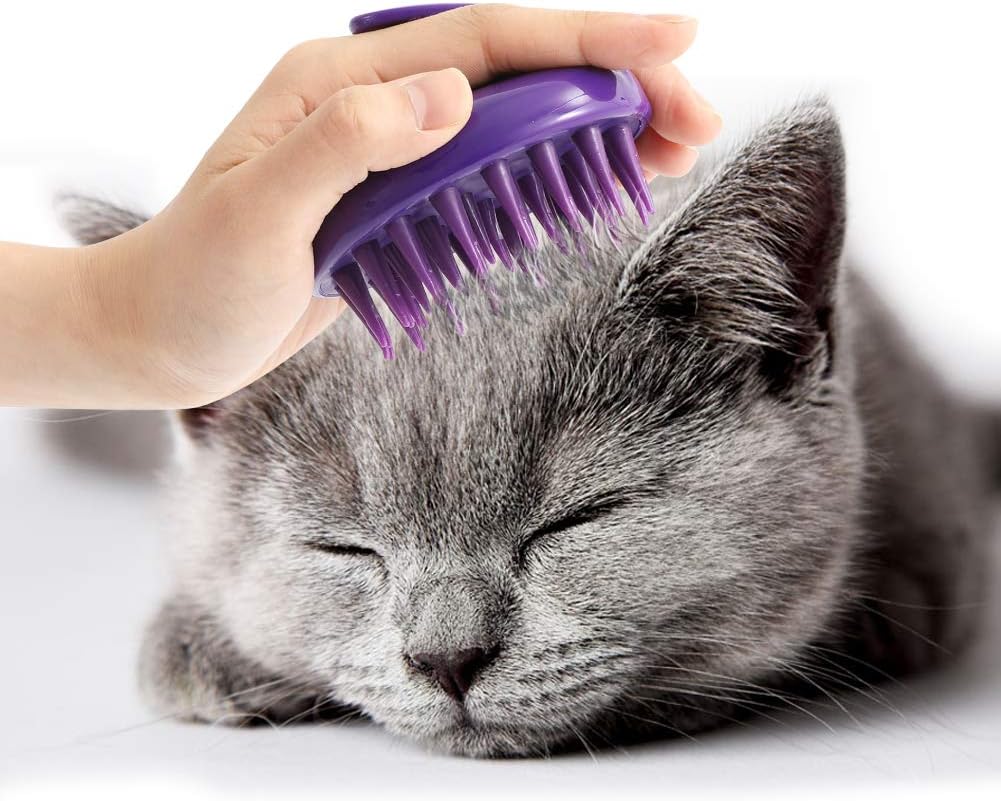
Pros
- Soft silicone rubber pins
- Rinses clean under tap water
- Non-slip grip
Cons
- Works mostly on the outer coat
- Long coats still need a comb
Pros
- Coarse and fine teeth
- Rounded pin ends
- Stainless steel, about 2.5 oz
Cons
- Lifts less surface hair on short coats
- Not a mat remover

Pros
- Thick stainless steel scissor blades
- Built-in spring and non-slip handles
- Compact 4.72 in, made for cats and small dogs
Cons
- No stop guard or light
- Not for large-breed nails
Frequently Asked Questions
How often should you brush a cat?
It depends on the coat. The ASPCA suggests once or twice a week for most cats and every few days for indoor long-haired cats, while International Cat Care suggests at least weekly for short hair and at least daily for long hair.
Do cats need baths?
Most healthy adult cats rarely do. A bath may help if a cat is very dirty, gets into something sticky or smelly, or cannot groom well because of arthritis or weight. Use a cat shampoo and ask your veterinarian if baths seem to be needed often.
How often should you trim a cat’s nails?
VCA suggests every two to four weeks for indoor cats. Some cats keep their claws in shape by scratching, so check for claws catching on fabric or clicking on floors, especially in older cats.
Can you cut mats out of cat fur with scissors?
No. It is easy to cut the skin by accident. Tease out small tangles gently and leave larger or severe mats to a groomer or your veterinary team.
Should you clean a cat’s ears?
Check them weekly. You can wipe visible debris from the ear flap with a cleaner your veterinarian suggests on a cotton ball, but never go inside the ear canal. Wax buildup, odor or discharge needs a vet check.
Sources
- ASPCA: Cat Grooming Tips
- International Cat Care: Grooming Your Cat
- VCA Animal Hospitals: Grooming and Coat Care for Your Cat
- VCA Animal Hospitals: How to Trim a Cat’s Nails
- Cornell Feline Health Center: The Danger of Hairballs
About the author
Daniel Mitchell covers grooming and coat care, including bathing, brushing, nail trimming and grooming tools, plus pet hair removal and washing pet beds and gear. Guides follow product care labels and manufacturer instructions and recommend a professional groomer or veterinarian when a pet needs specialist handling. Daniel Mitchell does not hold veterinary or professional grooming credentials.