
5 Best Puppy Food Picks for Small and Large Breeds
Five puppy foods with AAFCO growth statements for small and large breeds, plus how much to feed and when to switch to adult food.
 By Olivia Parker
Updated November 18, 2026

The best puppy food is a complete and balanced formula whose label says it is made for growth, or for all life stages, and that fits the size your puppy will be as an adult. If your puppy is expected to weigh 70 pounds or more, look for wording that includes growth of large size dogs, a point VCA Animal Hospitals stresses for large and giant breeds. Your veterinarian can help you confirm the right formula and amount at each checkup.
Below are five puppy foods from three manufacturers: three dry formulas sized for all breeds, small breeds or large breeds, one mid-size bag with a mixed texture and one wet food. Each pick lists its AAFCO statement as published by the manufacturer. If you are still setting up for your puppy’s arrival, our new puppy checklist covers bowls, beds and the other basics.
Our Top Picks
These picks are ordered by how well they fit common puppy needs, not by any score. Check the nutritional adequacy statement and feeding guide on the bag or can before you buy, since formulas and package sizes can change.
Pros
- AAFCO all life stages incl. large-size growth
- Feeding-trial statement
- Chicken is the first ingredient
Cons
- 34 lb bag is a lot for toy puppies
- Not size-specific kibble

Pros
- Made for puppies over 55 lb as adults
- Calcium level aimed at controlled bone growth
- Feeding-trial growth statement
Cons
- Large breeds only
- Not for adult dogs

Pros
- For 9 to 22 lb adult weight
- Small crunchy kibble
- AAFCO growth statement
Cons
- Not for toy or large breeds
- Formulated, not feeding-trial statement

Pros
- Growth incl. large-size dogs
- 16.5 lb bag
- Kibble plus tender morsels
Cons
- Not size-specific kibble
- Piece size varies
Pros
- Wet pate for picky eaters or mixing
- AAFCO growth of puppies statement
- 12 x 13 oz cans
Cons
- Opened cans need refrigeration
- US statement omits large-size growth
For all breed sizes, including large breeds: Purina Pro Plan Puppy Chicken & Rice
This dry food suits owners who want one puppy formula that covers small, medium and large puppies. Purina’s label statement is based on feeding tests and covers all life stages, including growth of large sized dogs, so it works for a puppy whose adult size is hard to predict.
- AAFCO statement: feeding tests using AAFCO procedures substantiate complete and balanced nutrition for all life stages, including growth of large sized dogs (70 lb. or more as an adult), per the Purina Pro Plan Puppy Chicken & Rice label
- Dry kibble with chicken as the first ingredient (Amazon listing)
- Listing says it includes DHA from fish oil, plus calcium, phosphorus and other minerals for bones and teeth
- 34 lb bag
Consider: a 34 lb bag is a lot of food for a toy or small puppy, and smaller bags are sold as separate listings. The kibble is not size-specific, and the recipe is chicken-based.
For large breeds: Hill’s Science Diet Puppy Large Breed Chicken & Brown Rice
This is the only large-breed-specific formula in this guide. Hill’s makes it for puppies expected to weigh over 55 pounds as adults and recommends it up to 18 months old, which fits the longer growth period of big dogs.
- AAFCO statement: feeding tests using AAFCO procedures substantiate complete and balanced nutrition for growing puppies, per Hill’s product page
- Hill’s says it is made with an optimal level of calcium for controlled bone growth
- First ingredients: chicken, brown rice, whole grain oats, chicken meal, cracked pearled barley, chicken fat
- Listing says it includes DHA and a prebiotic fiber blend; 15.5 lb bag
Consider: it is made only for large-breed puppies, so it is not a fit for small or medium breeds, and Hill’s does not recommend it for adult dogs. The recipe is chicken-based.
For small breeds: Royal Canin Small Puppy
This dry food suits small-breed puppies with an expected adult weight of 9 to 22 pounds. The kibble is sized for small mouths, and the formula is meant to be fed up to about 10 months, which lines up with the earlier switch to adult food that small breeds make.
- AAFCO statement: formulated to meet the nutritional levels established by the AAFCO Dog Food Nutrient Profiles for growth, per Royal Canin’s product page
- For puppies 2 to 10 months old with an expected adult weight of 9 to 22 lb (Amazon listing)
- Small crunchy kibble; listing says it includes DHA, antioxidants such as vitamins E and C, and prebiotics
- 14 lb bag; can be mixed with Royal Canin Small Puppy wet food, sold separately
Consider: it is not meant for toy puppies expected to weigh under 9 pounds, or for medium and large breeds. The statement is a formulation claim rather than a feeding trial claim.
For a mid-size bag: Purina ONE +Plus Healthy Puppy
This dry food suits owners who want a smaller bag than a 30-plus pound sack while keeping a growth statement that covers all breed sizes. It mixes crunchy kibble with tender meaty morsels, which some owners prefer for a picky puppy.
- AAFCO statement: feeding tests using AAFCO procedures substantiate complete and balanced nutrition for growth of puppies and gestation/lactation, including growth of large sized dogs (70 lb. or more), per Purina ONE’s product page
- Real chicken is the first ingredient, with rice and oatmeal (Amazon listing)
- Listing says it includes DHA and natural sources of glucosamine, with no artificial flavors or preservatives
- 16.5 lb bag
Consider: the kibble is not sized for a specific breed, and the mix of kibble and morsels means piece size varies. The recipe is chicken-based.
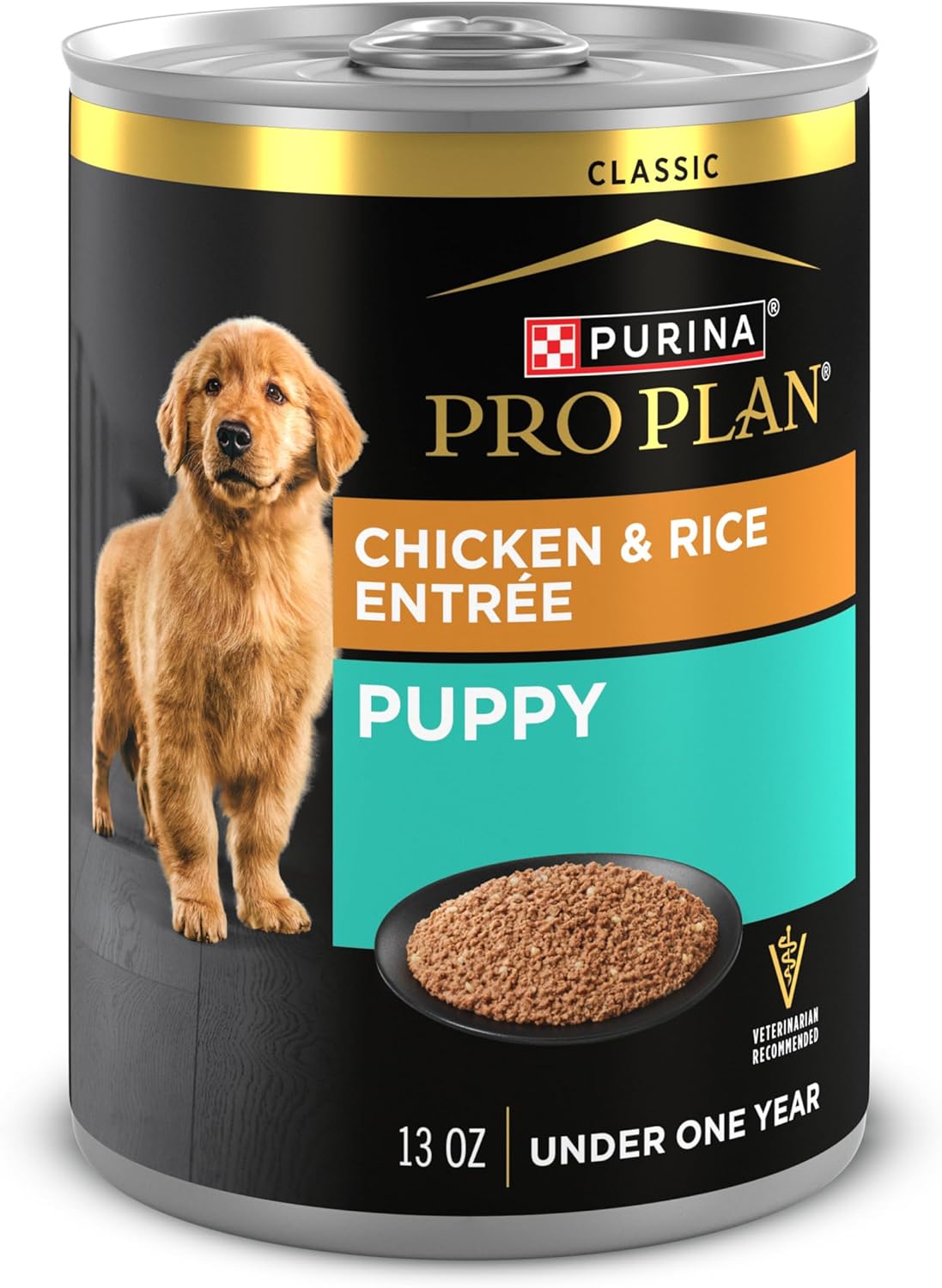
For a wet puppy food: Purina Pro Plan Puppy Chicken & Rice Entree
This canned pate suits picky eaters, puppies that do better with softer food, or owners who want to mix a little wet food into kibble. The listing says it is made for puppies up to 1 year old, or up to 2 years for larger breeds.
- AAFCO statement: formulated to meet the nutritional levels established by the AAFCO Dog Food Nutrient Profiles for growth of puppies, per Purina’s product page
- Pate texture with chicken as the first ingredient (Amazon listing)
- Listing says it includes DHA and has no artificial colors, flavors or preservatives
- Case of 12 cans, 13 oz each
Consider: opened cans need to be refrigerated, and a 12-can case goes quickly if a big puppy eats only wet food. The US statement shown does not mention growth of large size dogs, so owners of large-breed puppies should check the can label and ask their vet before making it the main diet.
Puppy Food Comparison
| Product | Form | Made for | AAFCO statement | Package |
|---|---|---|---|---|
| Purina Pro Plan Puppy Chicken & Rice | Dry kibble | All sizes, including 70 lb+ adults | All life stages, including large-size growth (feeding tests) | 34 lb bag |
| Hill’s Science Diet Puppy Large Breed | Dry kibble | Large breeds, over 55 lb as adults | Growing puppies (feeding tests) | 15.5 lb bag |
| Royal Canin Small Puppy | Dry kibble | Small breeds, 9 to 22 lb as adults | Growth (formulated) | 14 lb bag |
| Purina ONE +Plus Healthy Puppy | Dry kibble and morsels | All sizes, including 70 lb+ adults | Growth, including large-size growth (feeding tests) | 16.5 lb bag |
| Purina Pro Plan Puppy Chicken & Rice Entree | Wet pate | Puppies, picky eaters, mixing | Growth of puppies (formulated) | 12 x 13 oz cans |
How to Choose a Puppy Food
Start with the label, then match the food to your puppy’s expected adult size and to your routine.
- Read the nutritional adequacy statement. AAFCO calls it perhaps the most important part of a label. For a puppy, it should say the food is for growth or for all life stages. VCA notes that all life stages foods are also considered appropriate for growth.
- Know the two kinds of statements. “Formulated to meet the nutritional levels established by the AAFCO Dog Food Nutrient Profiles” means the recipe was built to the profile. “Animal feeding tests using AAFCO procedures substantiate” means the food went through standardized feeding trials.
- Match the expected adult size. Small-breed formulas tend to have smaller kibble and an earlier switch age. Large-breed puppies need a statement that covers large-size growth or a dedicated large-breed formula.
- Pick a form you can stick with. Dry food is easy to measure and store. Wet food can help a picky eater, but opened cans need refrigeration.
- Buy a bag size you will finish. A huge bag can be convenient for a large puppy and too much for a toy breed.
If your puppy has a medical condition, ongoing digestive upset or a food your vet wants you to avoid, ask your veterinarian before choosing. For grown dogs with tummy trouble, see our guide to the best dog food for sensitive stomachs.
Why Large-Breed Puppies Need a Large-Breed Formula
Large and giant breed puppies grow for a long time, and how fast they grow matters. According to VCA, puppies cannot regulate calcium absorption the way adult dogs do, and excess calcium can cause skeletal malformations. Large-breed formulas differ from other puppy foods in calcium, phosphorus and the ratio between them.
Calories matter too. VCA explains that a puppy taking in more calories than it needs will gain excess weight, and growing too quickly can stress developing bones and joints. That is why VCA suggests looking for a statement that the food is formulated for growth of puppies including large dogs, meaning more than 70 pounds as an adult.
Sources define “large breed” a little differently. The AAFCO label wording uses 70 pounds or more as an adult, while Hill’s recommends its large-breed puppy food for puppies expected to be over 55 pounds. If your puppy falls in between, ask your vet which formula fits.
Do not add vitamin or mineral supplements to a complete puppy food on your own. VCA’s guide to feeding growing puppies says to check with your veterinarian first, and the AKC gives the same advice, especially for large-breed puppies.
How Much to Feed a Puppy
Start with the feeding chart on the bag or can, then adjust with your veterinarian based on your puppy’s growth. VCA recommends measured portions at set times rather than leaving food out all day, partly because free access makes it harder to notice when a puppy starts eating less.
The AKC’s puppy feeding timeline gives a general meal schedule:
- 6 to 12 weeks: four feedings a day are usually adequate.
- 3 to 6 months: cut back from four meals to three.
- 6 to 12 months: begin feeding twice a day.
Treats count toward the daily total. VCA says no more than 10% of a puppy’s daily calories should come from treats or snacks, and the AKC suggests keeping training treats as small as possible and trimming meal portions on heavy training days. If you are working on reward-based lessons, our puppy training schedule by age shows what to teach and when.
VCA also recommends regular checks of your puppy’s weight, body condition and growth rate, so weigh-ins at vet visits are a good habit.
When to Switch to Adult Food
The right age depends mostly on your puppy’s expected adult size. According to the AKC, small breed puppies can switch to adult food at 7 to 9 months, while larger breeds may stay on puppy food until 12, 13 or even 14 months. VCA notes that large and giant breeds can take up to two years to reach adult weight and could be on puppy food for that long.
The AKC sums it up this way: it is better to be on puppy food a little too long than not long enough. When the time comes, make the change gradually over a few days rather than all at once, and ask your vet to confirm the timing for your dog.
Frequently Asked Questions
What should I look for on a puppy food label?
Look for the AAFCO nutritional adequacy statement. It should say the food is complete and balanced for growth or for all life stages. For a puppy expected to weigh 70 pounds or more, it should include growth of large size dogs.
Can a large-breed puppy eat regular puppy food?
Only if the label covers growth of large size dogs. VCA advises choosing a food formulated for growth of puppies including large dogs, because excess calcium and calories can affect developing bones and joints.
How many times a day should a puppy eat?
The AKC suggests about four meals a day from 6 to 12 weeks, three meals from 3 to 6 months and two meals from 6 to 12 months. Follow the feeding chart on the package and your vet’s advice for amounts.
When should I switch my puppy to adult dog food?
The AKC says small breeds can switch at 7 to 9 months and larger breeds at 12 to 14 months. VCA notes that large and giant breeds may need puppy food for up to two years. Switch gradually over a few days.
Is wet or dry puppy food better?
Both can be complete and balanced for growth, so check the label rather than the form. Dry food is easy to measure and store, while wet food can tempt a picky eater or be mixed into kibble.
Should I give my puppy supplements?
Not without talking to your veterinarian. VCA says a properly chosen puppy food should already meet a puppy’s needs, and the AKC advises speaking with your vet before adding supplements, especially for a large-breed puppy.
Conclusion
For one dry food that covers puppies of any size, Purina Pro Plan Puppy Chicken & Rice has a feeding trial statement that includes large-size growth, and Purina ONE +Plus Healthy Puppy offers similar coverage in a 16.5 lb bag. For a puppy headed over 55 pounds, Hill’s Science Diet Puppy Large Breed is made for big dogs, while Royal Canin Small Puppy fits small breeds of 9 to 22 pounds. For a picky eater or a topper, Purina Pro Plan Puppy Chicken & Rice Entree is the wet option. Whichever you choose, feed measured meals, watch your puppy’s growth and check in with your vet.
Sources
- VCA Animal Hospitals: Puppy Nutrition, Feeding Large and Giant Breeds
- VCA Animal Hospitals: Feeding Growing Puppies
- American Kennel Club: Puppy Feeding Fundamentals
- AAFCO: Reading Labels
- Purina: Pro Plan Puppy Chicken & Rice Formula Label
- Hill’s Pet Nutrition: Science Diet Puppy Large Breed Dry Dog Food
- Royal Canin: Small Puppy Dry Dog Food
- Purina ONE: +Plus Healthy Puppy Formula
- Purina: Pro Plan Puppy Chicken & Rice Entree Wet Puppy Food
About the author
Olivia Parker covers cat litter types, litter box habits and common litter problems, plus food choices and feeding routines for dogs and cats. Guides draw on sources such as the ASPCA, the Cornell Feline Health Center and veterinary hospital guidance, and recommend talking to a veterinarian before changing a pet's diet or when litter habits suddenly change. Olivia Parker does not hold veterinary or nutrition credentials.