
Best Dog Crates by Size and Type
Compare wire, plastic, soft and aluminum dog crates by size and type, with manufacturer specs, a comparison table and tips for sizing puppy crates.
 By Best Pet Supplies Guide
Updated November 6, 2026

The best dog crate depends more on your dog’s size, age and chewing habits than on any single brand. For most growing puppies, a wire crate with a divider is the practical starting point. Plastic kennels suit dogs that like a more enclosed space, soft crates suit calm small dogs that do not chew, and folding aluminum crates are a specialty option for owners who want something sturdier than wire.
Here is the short version by dog type:
- Puppies: a wire crate with an adjustable divider, sized for the adult dog.
- Small dogs: a top-load plastic kennel, or a soft crate if your dog does not chew fabric.
- Medium dogs: a wire or plastic crate in the middle sizes. Compare the manufacturer’s dimensions with your dog’s measurements.
- Large dogs: wire, plastic or aluminum crates in the largest sizes. Check the exact dimensions, because some large sizes ship by freight.
- Dogs that chew or push hard: wire or rigid metal, not fabric.
Crate Types: Wire, Plastic, Soft and Heavy-Duty
The American Kennel Club (AKC) compares the main crate materials and says every crate needs ventilation holes or mesh. It also recommends a sturdy crate that suits your dog’s age and breed and is easy to set up and take down. Some dogs also like the view a wire crate offers, according to the AKC’s crate training guide.
| Type | Pros | Cons |
|---|---|---|
| Wire / metal | Suits dogs that chew. The AKC calls it the sturdiest you can buy. Good ventilation and visibility. | Not the most attractive. You can drape a fabric cover over it. |
| Plastic | Used at home and for travel. Durable, well ventilated and easy to wipe clean. | More enclosed, so your dog sees less of the room. |
| Soft / fabric | Budget-friendly for small dogs that do not chew. Lightweight, easy to set up and folds for storage. | Harder to clean after an accident. |
| Wood | The best looking, and some styles double as furniture. | The most expensive type. Heavy, needs assembly and is hard to clean. |
| Rigid aluminum / metal (heavy-duty) | Rigid metal construction. Some models fold flat for transport. | Heavier than soft crates and a bigger up-front investment than a basic wire crate. |
The AKC does not treat heavy-duty as its own category. In this guide it means rigid aluminum or metal crates as described by their manufacturers. The pros and cons in that row are general practical guidance, not AKC findings.
You can browse more options in our dog crates and playpens category.
Our Top Picks: Best Dog Crates by Size and Type
Each pick below uses only the manufacturer’s listed specs. Always compare the dimensions with your own dog’s measurements before you buy.
One more pick, the Impact Dog Crates collapsible crate, is covered below with the others.

Pros
- Divider panel adjusts the space for a growing puppy
- Front and side doors
- Folds flat, with a top handle
Cons
- Tray hook must be locked after every setup
- Wire is not the prettiest option, as the AKC notes

Pros
- Listed for dogs of 20 to 30 lb
- Ventilation on four sides
- Stay-dry moat and a wipe-clean shell
Cons
- Too small for a large dog
- Confirm air travel rules with your airline

Pros
- Top door makes it easier to lift a small dog in
- Listed for pets of 5 to 15 lb
- Front door as well as the top door
Cons
- A growing medium or large puppy will outgrow it quickly
- Comes in only two sizes
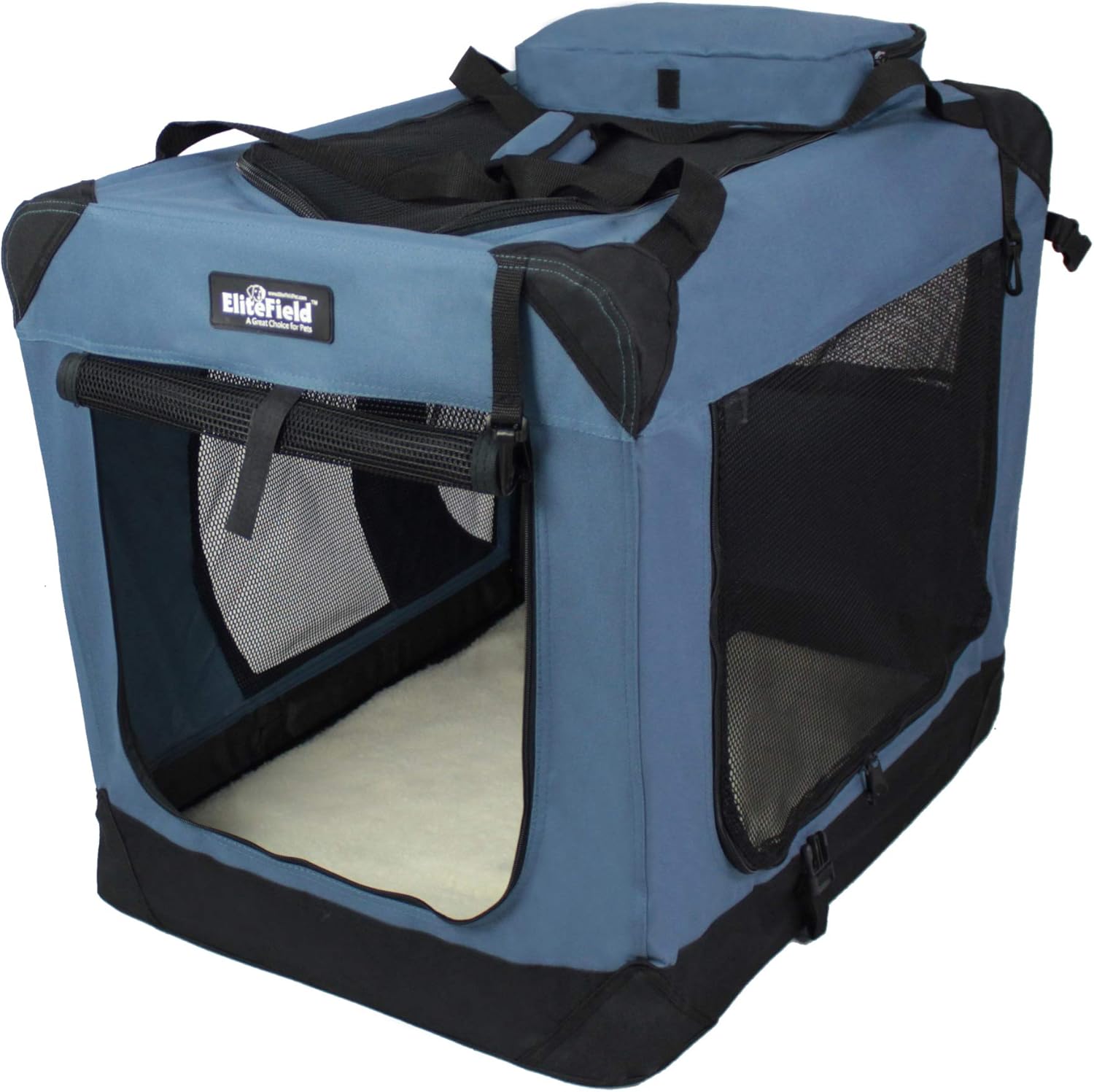
Pros
- Sets up and folds without tools
- Folds to about 3 in high
- Includes a carrying bag and fleece bed
Cons
- Not for dogs that chew or scratch at fabric
- Harder to clean after accidents, per the AKC
- Poor match for puppies still house training
For growing puppies: Amazon Basics Foldable Metal Wire Dog Crate with Tray, Double Door
This is a straightforward wire crate for house training a puppy that will get bigger. The built-in divider panel lets you shrink the interior now and open it up later. It comes in several common sizes, so it can also work for adult dogs of many sizes.
Key specs (per the manufacturer):
- Wire crate with two doors, front and side.
- Divider panel to adjust the interior space.
- Removable plastic base tray, with a metal hook at the bottom that keeps the tray from sliding out.
- Folds flat and has a top handle and a manual door locking mechanism.
- Sizes include 30 x 19 x 21 in, 36 x 23 x 25 in and 48 x 30 x 32.5 in. The 36-inch size is listed for pets under 32 x 21 in (L x H).
Consider: The listing says to lock the tray hook after every setup, so make that a habit after you move or fold the crate. Wire is also not the prettiest option, as the AKC notes. The listing says to add 4 inches to your dog’s measurements, while the AKC says 3 to 4 inches, so use the size guide below to settle on a number.
For dogs that like an enclosed crate: Petmate Vari Dog Kennel (28 in)
This plastic kennel suits dogs that seem to settle better in a more enclosed, den-like space. It works for home and travel, and the 28-inch size is listed for dogs of 20 to 30 lb. The stay-dry moat directs fluids away from your dog, which helps during house training.
Key specs (per the Amazon listing):
- Plastic shell with a wire door and ventilation on four sides.
- Exterior 28 x 20.5 x 21.5 in, interior 24.2 x 18.2 x 19.5 in.
- Tamper-proof holes for zip ties.
- Stay-dry moat, and a shell that wipes clean.
- For air travel, the listing says it meets most airline cargo specifications.
Consider: The 28-inch size is too small for a large dog, so compare the interior size with your dog’s measurements. If you plan to fly, confirm the requirements with your airline rather than relying on the listing.
For small dogs: Petmate 2-Door Top Load Kennel
This kennel is meant for toy and small dogs, and Petmate lists it for pets of 5 to 15 lb. The top door makes it easier to lift a small dog in or out, which helps on trips to the vet. It comes in two sizes, 19 and 24 inches.
Key specs (per the manufacturer):
- Front door plus a top door.
- Heavy-duty plastic and steel wire, described as easy to assemble.
- Interior of the 19-inch size is 16.75 x 11 x 9.25 in. The 24-inch size is 21 x 14.5 x 13.5 in.
- Made in the USA from EcoTEC plastic, which is a minimum of 90% pre-consumer recycled material. Other components are imported.
Consider: The 15 lb listed limit and the 24-inch maximum size mean a growing puppy of a medium or large breed will outgrow it quickly. Use it for toy breeds or as a small carrier, not as a long-term crate for larger dogs.
For calm dogs on the go: EliteField 3-Door Folding Soft Dog Crate
This soft crate suits calm dogs that do not chew or scratch at fabric. It is a good fit for hotels, events and trips where you want something light that stores flat. The brand sells it in multiple sizes, and the 42-inch size measures 42 x 28 x 32 in.
Key specs (per the brand’s listing):
- Steel tube frame with a 600D fabric cover and hex mesh.
- Three mesh doors (top, front and side). The front and side doors zip.
- Arrives fully assembled, sets up and folds without tools, and folds to about 3 in high.
- Includes a carrying bag and fleece bed, plus two accessory pockets. The crate cover and bed cover are removable and washable.
- Handle and carry straps, with a 2-year warranty.
Consider: The AKC says soft crates suit dogs that will not chew and are harder to clean after accidents. That makes this a poor match for puppies still learning house training or for dogs that paw at fabric. The specs above come from EliteField’s own brand listing.
For a sturdier folding crate: Impact Dog Crates Collapsible Dog Crate
This is a rigid aluminum crate for owners who want a metal crate that still folds flat for the car. Impact’s Amazon listing says it is stronger than a wire crate, but that its hinges and folding design are not ideal for escape-prone or anxious dogs. Impact sells it in seven sizes from 24 to 54 inches on its own site; sizes on Amazon can differ, so check the listing.
Key specs (per the manufacturer):
- Precision-cut aluminum that folds flat.
- Built-in stationary brackets, with 8 stationary screws included.
- Door options are a Diamond-Vent Door or a Bar Door.
- Sizes: 24″ Small (24.5 x 18.5 x 23 in), 30″ Medium (30.5 x 20.5 x 26), 34″ Intermediate (34.5 x 23 x 29), 40″ Large (40.5 x 23 x 29), 40″+ Extra Large (40.5 x 27 x 33), 48″ Double Extra Large (48 x 27 x 33) and 54″ Triple Extra Large (54.5 x 35.5 x 42).
- Lifetime manufacturer warranty on materials and workmanship, which excludes damage caused by dogs.
Consider: Expect a bigger up-front investment than a basic wire or soft crate, and more weight than fabric. Because the warranty excludes damage caused by dogs, a metal crate does not replace training. If your dog is hurting itself trying to get out, talk to your veterinarian or a qualified trainer.
Comparison Table
| Product | Type | Main material | Sizes listed by the manufacturer | Notable feature |
|---|---|---|---|---|
| Amazon Basics Foldable Metal Wire Dog Crate with Tray, Double Door | Wire | Metal wire with plastic tray | Includes 30 x 19 x 21 in, 36 x 23 x 25 in and 48 x 30 x 32.5 in | Divider panel and two doors |
| Petmate Vari Dog Kennel (28 in) | Plastic kennel | Plastic shell with wire door | Interior 24.2 x 18.2 x 19.5 in | Four-sided ventilation and stay-dry moat |
| Petmate 2-Door Top Load Kennel | Plastic kennel | Plastic and steel wire | 2 sizes, 19 and 24 in | Front door plus top door |
| EliteField 3-Door Folding Soft Dog Crate | Soft | Steel tube frame with 600D fabric and mesh | Multiple sizes, including 42 x 28 x 32 in | Three mesh doors, folds to about 3 in high |
| Impact Dog Crates Collapsible Dog Crate | Rigid metal | Aluminum | 7 sizes, 24 to 54 in | Folds flat, with Diamond-Vent or Bar Door options |
Dimensions are as each manufacturer lists them. Petmate gives interior measurements for its kennels, so check each listing to see whether a size is interior or exterior before you compare.
How to Choose a Dog Crate
Start with your dog’s size
Measure your dog while standing. Measure height from the top of the head to the paws, and length from the nose to the tail. The AKC says to add 3 to 4 inches to each measurement. Your dog should be able to sit, stand and lie down comfortably, and the AKC warns that a crate that is too roomy can lead a dog to go to the bathroom inside it.
Our dog crate size guide walks through the measurements in more detail.
Choose a divider for puppies
For a puppy, the AKC suggests choosing a crate based on the breed’s adult size and using a divider to adjust the space as the dog grows. A wire crate with a divider, like the Amazon Basics model above, does this job. Check that the divider panel locks securely and that your puppy cannot squeeze behind it.
Puppies also need breaks. Humane World for Animals advises that dogs under 6 months should not stay in a crate for more than 3 to 4 hours at a time, and that a crate should never be used as punishment. If your dog seems distressed in the crate, talk to your veterinarian.
Look at the floor, tray and bedding
A removable tray, as on the Amazon Basics crate, makes cleanup easier after accidents. If you use bedding, pick something washable. The AKC suggests adding a washable pad or mat only if your dog does not chew fabric, so use no bedding at all for a dog that shreds it. Our guide on how to clean a dog bed covers washing mats and covers.
For crate floors that have been soiled, an enzyme cleaner for pet urine is worth reading up on, especially with soft crates, which are harder to clean.
Match the crate to the room and the routine
Where the crate sits matters as much as which one you buy. See where to put a dog crate for room-by-room guidance. For cars, secure the crate so it cannot slide, and follow the crate maker’s own instructions.
Safety basics
Take your dog’s collar off whenever the dog is in the crate, as the AKC’s crate training guide recommends. Pick a crate that is easy to assemble and take apart, with ventilation holes or mesh on the sides. Check that latches close fully each time you set it up.
Frequently Asked Questions
What size crate does a dog need?
Measure your dog standing, from head to paws and from nose to tail, then add 3 to 4 inches to each measurement, as the AKC advises. Your dog should be able to sit, stand and lie down comfortably. Use the manufacturer’s size chart to match those numbers to a crate.
Is a wire or plastic crate better?
Neither is better for every dog. The AKC describes wire crates as the sturdiest you can buy, with good ventilation and visibility. It describes plastic crates as durable, well ventilated, easy to clean and suited to home and travel use. Wire usually suits dogs that chew, and plastic suits dogs that prefer a more enclosed space.
What is the difference between a dog crate and a kennel?
As general guidance, people often use the two words interchangeably. Some brands call a plastic carrier-style crate a kennel. Compare the material, size, door layout and features listed on the product page rather than relying on the name.
What size crate should I buy for a puppy?
Buy for the adult size of the breed and use a divider to shrink the space while the puppy is small. A divider keeps the crate from being too roomy, which the AKC says can lead to bathroom accidents inside it.
How long can a puppy stay in a crate?
According to Humane World for Animals, puppies under 6 months should not be crated for more than 3 to 4 hours at a time. Talk to your veterinarian about the right schedule for your puppy.
Can I use a soft crate for a dog that chews?
The AKC says soft crates suit small dogs that will not chew. For dogs that chew, the AKC points to wire or metal crates instead. If your dog chews destructively or gets distressed in a crate, ask your veterinarian or a qualified trainer for advice.
Conclusion
Start with your dog’s measurements, then match the crate to how you will use it. For a growing puppy, the Amazon Basics wire crate has a divider panel. For a dog that settles better in an enclosed space, look at the Petmate Vari Dog Kennel. For toy and small dogs, the Petmate 2-Door Top Load Kennel is easier to lift a dog in and out of. For a calm dog on the go, the EliteField soft crate folds flat. For a sturdier metal crate that folds for the car, the Impact collapsible crate is the rigid option, though Impact does not recommend it for escape-prone or anxious dogs and no crate replaces training.
Sources
- American Kennel Club, How to Choose the Best Crate for Your Dog
- American Kennel Club, How to Crate Train a Dog
- Humane World for Animals, Crate Training 101
- Amazon Basics, Foldable Metal Wire Dog Crate with Tray, Double Door (product listing)
- Petmate, Vari Dog Kennel, 28 in (product listing)
- Petmate, 2-Door Top Load Kennel
- EliteField, 3-Door Folding Soft Dog Crate (brand listing)
- Impact Dog Crates, Collapsible Dog Crate
- Impact, Collapsible Dog Crate, 40 in (product listing)
About the author

Best Pet Supplies Guide publishes research-based buying guides, size guides and care how-tos for dog, cat and pet home supplies, using manufacturer specifications and guidance from reputable pet-care organizations.