
Puppy Crying in the Crate: What to Do
Puppy crying in the crate? Check potty, timing and exercise first, then build a calm routine with rewards and keep the crate near you at night.
 By Michael Bennett
Updated November 14, 2026

When a puppy cries in the crate, first check the basics: does the puppy need to go potty, has it been in there too long, and has it had a chance to burn off energy? If those are covered, work gradually on making the crate a place the puppy likes, and keep the crate close to you at night. The sources below disagree a little on how fast to respond to crying, so this guide says which source recommends what.
Rule out needs first
Crying is not always a training problem. PetMD’s veterinary behaviorist author lists several reasons a puppy may cry: fear or frustration at not being able to leave, missing littermates, stress at being alone, wanting attention when hearing the family move around, or needing to pee after being left too long. She calls crying a normal response for puppies separated from their litter, but stresses that it is important to minimize their stress.
Work through this quick checklist before anything else:
- Potty: PetMD gives a simple guide of the puppy’s age in months plus one hour as the longest gap between potty trips. That works out to about 3 hours at 2 months and up to 5 hours at 4 months. VCA similarly says never to leave a puppy in its crate longer than it can control its bowels or bladder, and notes that a 2-month-old may manage up to 3 hours.
- Exercise: VCA advises giving the puppy exercise and a chance to eliminate before it goes into the crate.
- Time in the crate: If you are unsure how long is too long, see our guide on how long a dog can stay in a crate.
PetMD also says a puppy should not scream for hours in a crate. Prolonged screaming may point to fear, pain, hunger or a need to go out, so a puppy that cannot settle is worth mentioning to your veterinarian.
Make the crate a good place
A puppy that links the crate with good things is more likely to settle in it. Humane World for Animals suggests feeding meals in the crate. Start with the bowl near the crate, then move it a little farther inside at each meal. You can then close the door during meals and slowly build up to about 10 minutes after the puppy finishes eating.
If the puppy whines to get out during this process, Humane World says you have probably increased the time too quickly. Go back a step. The same source suggests luring the puppy in with food or toys, and leaving a few safe toys in the crate when the puppy is out. If you are just starting out, see how to crate train a puppy in six steps.
VCA also recommends placing treats in the crate during the day so the puppy walks in on its own. At bedtime, VCA suggests putting the puppy in with water, a toy and a treat. PetMD adds soft bedding (if the puppy does not chew it), age-appropriate toys, a pheromone diffuser and quiet music as options.
For the full list of supplies to have ready before the puppy comes home, see our new puppy checklist.
The first nights
Some puppies sleep through the night right away and some cry for a few nights, according to the AKC. The AKC advises putting the crate in your bedroom, since a puppy feels more secure with you nearby. It also suggests a blanket or stuffed toy that smells like the puppy’s mother, placed in the crate. If you are choosing a spot, our guide on where to put a dog crate covers the options.
The AKC says that if the puppy cries, you can put the crate next to your bed and put your hand inside to reassure the puppy. It also warns not to bring the puppy into your bed unless that is where you want it to sleep.
What the sources say about responding
The sources do not agree completely, so here is how each describes it:
- VCA: Its veterinary behaviorists say escape behavior and vocalization are expected when a dog is first crated. For short or mild complaints they say to ignore the puppy until the crying stops, never release the puppy unless it is quiet, and not to go to the dog if it cries at night. They also caution that interrupting the crying can make vocalizing worse in a very anxious pet.
- PetMD: If the puppy quiets within a few minutes, you do not need to go back. If crying goes past about 2 minutes, respond briefly with your voice, repeating 2 to 3 times. If the crying gets heavier or lasts longer, go back and comfort the puppy, which PetMD says matters when a puppy is panicking.
- Humane World: If you have followed the training steps and never let the puppy out for whining, try to ignore the whining, because a puppy that is only checking whether whining works usually stops soon. If it continues after a few minutes, say the phrase the puppy links to going outside to potty.
Where they overlap: a possible potty need should be handled calmly and briefly, and none of them suggests punishing the puppy for crying.
Comfort items for the crate
PetMD lists a soft T-shirt that smells like you, or a plush toy with a warm pouch and heartbeat, placed in or near the crate. It also describes draping a blanket over the crate to feel like a den and cut down on stimulation. We cover the pros and cons in should you cover a dog crate. The AKC’s separation anxiety article adds a blanket-wrapped warm water bottle and a ticking clock as things that may help a puppy settle.
Night potty breaks
Many young puppies simply cannot wait until morning. The AKC says some puppies need to go out in the middle of the night, and that this usually ends by 4 to 5 months of age. VCA says many puppies can control themselves through the night by 3 months. Ages vary, so use your puppy’s behavior rather than a fixed date.
- Take the puppy out right before bed. The AKC says it does not matter whether bedtime is 8 p.m. or midnight, as long as it becomes a routine.
- If the puppy fusses in the night, carry it out quietly for what the AKC calls a quick, boring potty break.
- Put the puppy straight back in the crate.
Humane World puts it the same way: the trip should have a purpose and should not be playtime. If you are fairly sure it does not need to go, Humane World suggests ignoring the whining until it stops.
Crying during the day
Daytime crying often comes from being alone or from hearing the family nearby. PetMD recommends placing the crate where the family spends time. Some families use one crate for the day and a second one in the bedroom for the night.
Keep early sessions short and build them up. If the puppy keeps crying, PetMD suggests leaving it alone for a shorter time and increasing the time again gradually. Vigorous play beforehand can help a puppy rest, with options like tug or frozen food in a puppy food toy. PetMD notes, however, that a tired puppy still may not stop crying if it has already built a negative association with the crate.
The AKC’s separation anxiety article notes that dogs thrive on routine, so keep meals, walks and potty times steady. Be patient, gentle and consistent. If whining gets out of control, Humane World says you may need to restart crate training from the beginning.
When crying is distress
Some crying is normal, but panic is different. PetMD lists signs of stress when a puppy is alone in the crate: crying, whining, barking, howling, screaming, and scratching or chewing at the door or sides. The AKC describes crying in the crate, following you everywhere and restlessness at night as normal puppy behavior, so the signs above are about how strong and how lasting the distress is.
VCA says continued anxiety, destruction or vocalization in the crate may indicate separation anxiety, and a behaviorist may be needed. Humane World adds that a crate does not cure separation anxiety and that dogs can hurt themselves trying to escape. If your puppy is too frightened or stressed and crate training is not progressing, PetMD suggests consulting a board-certified veterinary behaviorist or a certified applied animal behaviorist.
What not to do
- Do not punish crying. Humane World says never to punish a dog for whining. VCA says the crate should not be used for punishment.
- Do not release the puppy during a crying burst. VCA says never to let the puppy out unless it is quiet.
- Do not rush the schedule. Humane World says whining to get out often means the time was increased too quickly, and PetMD suggests shorter alone time built up gradually.
- Do not skip the potty and exercise basics. VCA advises exercise and a chance to eliminate before every crate session.
Crate Gear for a Calmer Night
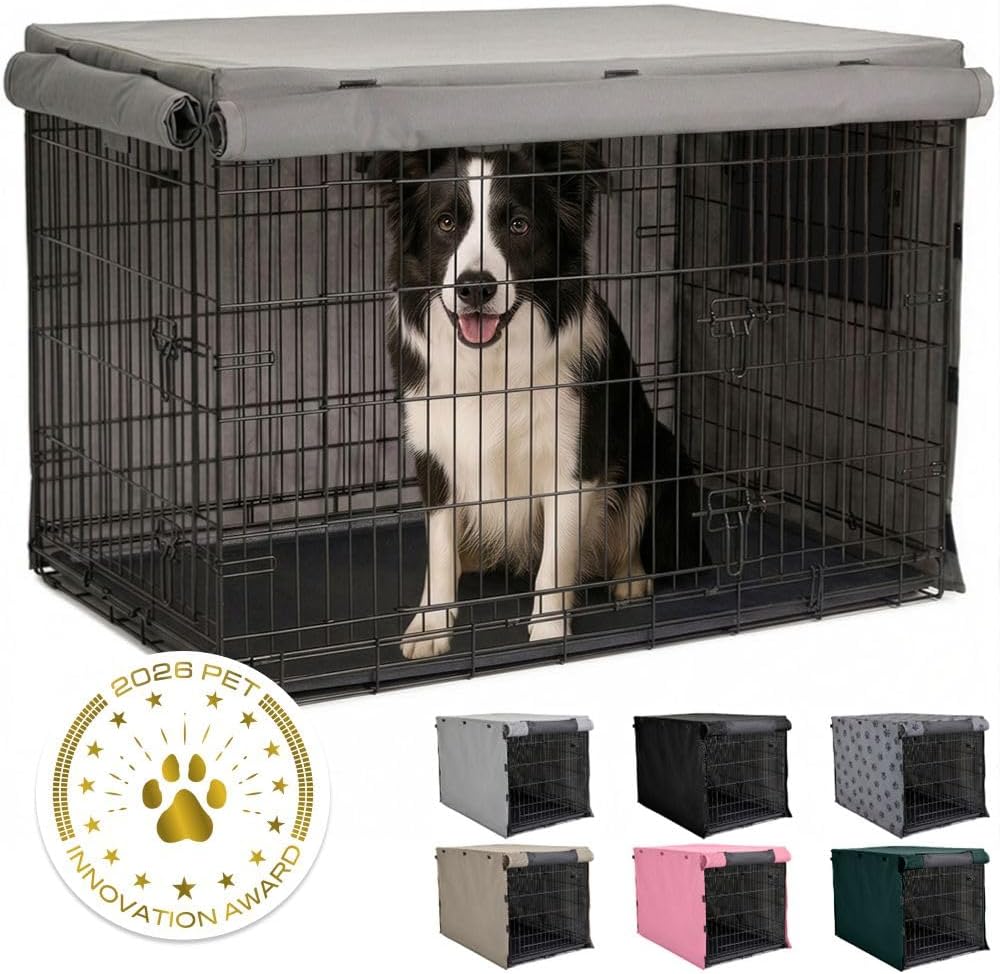
These items match the setup above: a crate that fits beside your bed, a cover for the den-like option PetMD describes, and a washable pad for a puppy that does not chew its bedding. For more crate choices, see our guide to the best dog crates.

Pros
- Divider panel adjusts the space for a growing puppy
- Front and side doors
- Folds flat, with a top handle
Cons
- Tray hook must be locked after every setup
- Wire is not the prettiest option, as the AKC notes

Pros
- Listed for dogs of 20 to 30 lb
- Ventilation on four sides
- Stay-dry moat and a wipe-clean shell
Cons
- Too small for a large dog
- Confirm air travel rules with your airline

Pros
- Sized for most 24-inch crates (about 24 x 18 x 19 in)
- Each side flap can be raised for airflow and visibility
- Works with 1, 2 and 3 door wire crates
- Teflon fabric protector helps spills bead up
- Machine washable
Cons
- For small crates only
- Measure your crate if it is not a MidWest model
Pros
- Front, back and side flaps all roll up
- Hook and loop straps at the base help stop sliding
- Light reducing, OEKO-TEX certified fabric
- Machine washable
Cons
- Light reducing fabric can hold heat if fully closed
- Fits 36 x 23 x 25 in crates, check your size
Pros
- Whole mat machine washable
- Foldable and lightweight
- Fits most standard crates
Cons
- Only about 1.5 in thick
- No waterproof layer listed
Frequently Asked Questions
Should I let my puppy cry it out in the crate?
It depends on the source and on the kind of crying. VCA says to ignore short or mild complaints until they stop. PetMD says to respond briefly after about 2 minutes and to comfort a puppy whose crying gets heavier or lasts longer. Always check potty needs first, and never treat prolonged panic as something to wait out.
How long will my puppy cry at night?
It varies. The AKC says some puppies sleep through the night immediately and others cry for a few nights. Needing a potty trip in the night usually ends by 4 to 5 months, according to the AKC.
Should I take my puppy out of the crate when it cries at night?
Only if it may need to go potty. The AKC suggests a quiet, quick, boring potty break and then straight back to the crate. If you are sure the puppy does not need to go, Humane World says to ignore the whining until it stops.
Should the crate be in my bedroom?
Several sources say yes for puppies. The AKC and Humane World both suggest keeping the crate in or near your bedroom at first, then moving it gradually once the puppy sleeps quietly.
Sources
- PetMD, Is Your Puppy Crying in Their Crate? Here’s What To Do
- American Kennel Club, Your First Day at Home With a New Puppy
- Humane World for Animals, How to Crate Train Your Dog or Puppy
- VCA Animal Hospitals, How to Crate Train Your Dog
- American Kennel Club, How to Help Your New Puppy Deal With Separation Anxiety
About the author
Michael Bennett covers crate training, puppy routines and beginner-friendly dog training, with an emphasis on reward-based methods and consistent schedules. He encourages readers to consult a qualified trainer or veterinary behaviorist for serious or persistent behavior concerns.