
5 Best Dog Boots for Winter: Snow, Salt and Cold Sidewalks
Five winter dog boot picks compared by lining, sole and closure, plus a paw wax for dogs that refuse boots, with sizing, training and paw care tips.
 By James Anderson
Updated November 27, 2026

The best winter dog boots fit the widest part of your dog’s paw, grip slick sidewalks and fasten snugly enough that your dog cannot kick them off. Booties help protect paws from salt, ice balls and cold temperatures, according to VCA Animal Hospitals, and many dogs need some practice before they accept them. If your dog refuses boots altogether, a paw wax is the fallback, and every pick below still works best with a quick paw wipe after each walk.
Below are five picks from five brands, each matched to a different winter need, followed by a comparison table, a sizing method and a step-by-step plan for getting your dog used to boots. If your dog also gets cold on walks, pair boots with a coat from our best dog clothes and coats for winter.
Our Top Picks
- For everyday walks on salted, slushy sidewalks: Canada Pooch Dog Snow Boots (Soft Shield)
- For small dogs that feel the cold: Spark Paws Dog Winter Boots (fleece lined)
- For medium and large dogs on a budget: QUMY Dog Snow Boots
- For active dogs on winter trails: Kurgo Blaze Dog Boots
- For dogs that will not wear boots: Musher’s Secret Paw Wax
Specs below come from each product’s Amazon listing and the brand’s own descriptions. Most winter boots are sold as water resistant rather than waterproof, so expect damp paws after long walks in deep slush, and always check the brand’s size chart before ordering.
Pros
- Water-resistant lined upper
- Rubberized grip sole for slush
- Toggle plus reflective strap
Cons
- Water resistant, not waterproof
- Soft sole, not for rocky trails

Pros
- Soft fleece lining
- Brand says waterproof material
- 8 sizes by paw width, machine washable
Cons
- Not insulated snow gear (brand)
- Fleece is slow to dry

Pros
- Wide split-seam opening
- Two adjustable reflective straps
- Sizes up to 3.0 in paw width
Cons
- No lining for warmth
- Seams can let water in; hand wash
Pros
- Dual ankle closure
- Interior lining, breathable mesh
- Reflective accents, all-season
Cons
- Mesh not for deep slush
- Spot clean only

Pros
- Wax barrier on paw pads
- Food-safe oils and waxes (brand)
- Option for dogs that refuse boots
Cons
- No warmth or traction
- Needs reapplying
For everyday walks on salted, slushy sidewalks: Canada Pooch Dog Snow Boots (Soft Shield)
This is the pick for the daily walk around the block when sidewalks are wet, salted and slushy. The brand built it for wet, cold conditions, with a lined, water-resistant upper, a rubberized grip sole and two closures at the top to help each boot stay in place.
- Set of 4 boots; water-resistant shell (96% polyester, 4% spandex) with a 100% polyester lining (Amazon listing)
- Brand says the upper helps shield paws from snow, salt, mud and moisture
- Rubberized grip sole for snowy, slushy and wet surfaces
- Adjustable toggle at the top plus a reflective hook-and-loop strap around the leg; wide opening for easier on and off
- Offered in multiple sizes; the brand asks you to measure your dog’s paws against its size chart
Consider: it is water resistant, not waterproof, so a long walk through deep slush can still soak through. The soft rubberized sole is made for city sidewalks rather than rocky trails, the lining is not described as insulation, and the listing gives two different care instructions, so follow the care label.
For small dogs that feel the cold: Spark Paws Dog Winter Boots (fleece lined)
Small and short-coated dogs often feel cold ground first. Spark Paws lines these boots with soft fleece and describes the material as waterproof, which makes them a good match for a small dog on frozen grass and salted sidewalks. The brand is honest that they are fleece lined for cold conditions rather than insulated snow gear.
- Pack of 4; soft fleece lining; nylon, polyester, fleece and PVC materials (Amazon listing)
- Brand describes the material as waterproof against rain, slush and puddles
- Dual hook-and-loop straps and a toggle lock; reflective straps and stitching
- Non-slip rubber soles; 8 sizes chosen by paw width (for example, size 6 is 2.7 x 3.1 inches, width x length)
- Machine washable, per the listing
Consider: by the brand’s own description these are not insulated snow boots, so they are not the choice for deep snow or long outings in severe cold. Fleece also holds moisture and takes longer to dry between walks. The brand notes that most dogs high-step at first and suggests a short indoor practice session.
For medium and large dogs on a budget: QUMY Dog Snow Boots
QUMY’s boots open wide along a split seam, which makes them easier to slide onto a bigger paw, and two adjustable straps tighten the fit. The size range runs up to a 3-inch-wide paw, so this is a practical all-season pair for medium and large dogs that walk on salt in winter and hot pavement in summer.
- Set of 4 shoes; wide split-seam opening; two adjustable, reflective hook-and-loop straps (Amazon listing)
- Rugged, slip-resistant rubber sole; faux leather, nylon, polyester, rubber and silicone materials
- 8 sizes by paw width, from size 1 (1.8 x 2.3 inches) to size 8 (3.0 x 3.3 inches); the brand says weight is only a secondary guide
- Listed uses include snow, rain and hot pavement; hand wash only
Consider: there is no lining for warmth, and QUMY’s own listings warn that water can seep through the seams, so treat them as water resistant at best. They are hand wash only, and a firm sole can feel strange to a dog at first.
For active dogs on winter trails: Kurgo Blaze Dog Boots
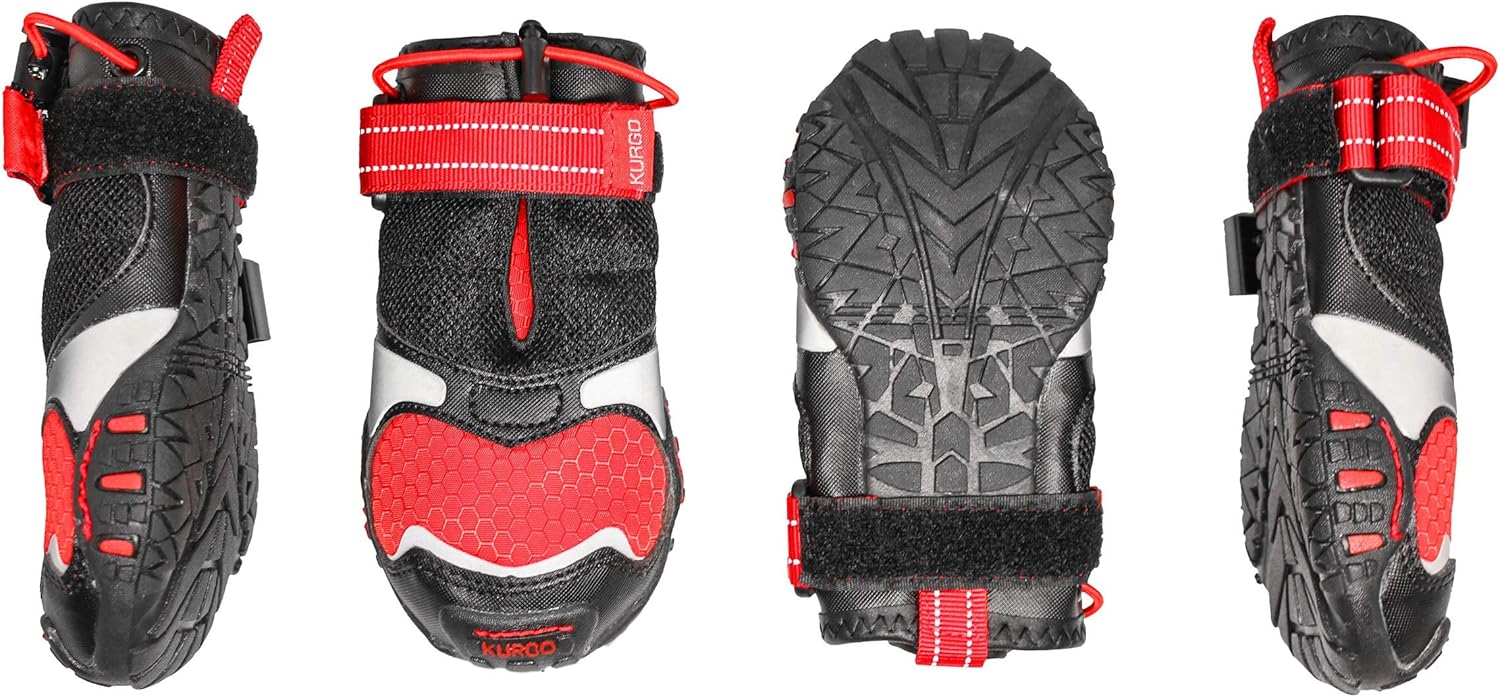
For dogs that hike, run or play hard in the snow, the Blaze adds a second closure at the ankle. Kurgo says the dual ankle closure and interior lining give a snug fit that stays in place through motion and play, and the sole is shaped to mimic a dog’s paw. The breathable mesh upper also makes these usable in summer.
- Set of 4; tightly woven nylon mesh upper described as water resistant and breathable (Amazon listing)
- Interior lining and dual ankle closure for a snug, adjustable fit
- Ergonomic sole shaped like a dog’s paw; reflective accents
- Brand says to measure the widest part of the paw while your dog is standing and compare it to the Kurgo chart
- Lifetime warranty when bought from an authorized seller, per the listing
Consider: breathable mesh is a trade-off in winter, since it is not made for soaking slush or deep snow, and the lining is not described as insulation. The listing says spot clean only, so salty boots need a wipe-down rather than a wash.
For dogs that will not wear boots: Musher’s Secret Paw Wax
Some dogs simply will not walk in boots. VCA suggests trying a protective balm in that case, since balm applied to the pads creates a barrier between icy, salty sidewalks and your dog’s paws. Musher’s Secret is a wax made from what the brand calls food-safe oils and waxes, and its listed uses include snow protection.
- 60 g (2.1 oz) tin with a screw-on cap (Amazon listing)
- Brand says it is made from food-safe oils and waxes and is safe even if your dog licks it
- Listed uses include snow protection, indoors and outdoors
- Care instructions say to avoid contact with eyes and store in a cool, dry place
Consider: a wax layer is a thinner barrier than a boot, with no warmth or added traction, and it needs reapplying. You still need to wipe salt off your dog’s paws after every walk.
Winter Dog Boots Compared
| Pick | Type | Lining | Closure | Water protection (per listing) | Care (per listing) |
|---|---|---|---|---|---|
| Canada Pooch Snow Boots | Boots, set of 4 | Polyester lining | Toggle + reflective strap | Water resistant | Follow care label |
| Spark Paws Winter Boots | Boots, set of 4 | Fleece | Dual straps + toggle | Brand says waterproof | Machine washable |
| QUMY Snow Boots | Boots, set of 4 | None listed | Two reflective straps | Water resistant at best | Hand wash |
| Kurgo Blaze | Boots, set of 4 | Interior lining | Dual ankle closure | Water resistant, breathable | Spot clean |
| Musher’s Secret | Paw wax | Not applicable | Not applicable | Wax barrier on pads | Reapply as needed |
Do Dogs Need Boots in Winter?
Not every dog needs boots, but many benefit from them on salted streets. Salt and deicers are harsh on paw pads and can be toxic if a dog licks them off its paws once inside, VCA explains. The ASPCA adds that booties give more coverage than a paw protectant and can keep sand and salt from getting lodged between the toes and causing irritation, according to the ASPCA.
Boots matter more for some dogs than others. Small dogs, short-legged dogs whose bellies touch the snow, puppies and senior dogs tend to feel the cold sooner, the AKC notes. Long-haired dogs are prone to painful ice balls between the toes, so keeping the fur on the feet trimmed also helps. On very cold days, shorten walks and head home if your dog shivers, whines or tugs at the leash.
How to Choose Winter Dog Boots
- Fit first. VCA says boots should be easy to get on and off, but not so easy that your dog kicks them off right away.
- Grip. Soles with grooves give better traction on slick sidewalks and uneven ground.
- Closures. Hook-and-loop straps are quick and fit snugly, and a second strap or toggle helps on active dogs.
- Reflective trim. Winter days are short, and reflective straps make your dog easier to see on dark walks.
- Water and warmth. A boot that traps water is uncomfortable, and moisture between the toe pads can raise the risk of yeast infections, according to the AKC. A lined boot adds warmth for snow play.
Nails matter too. The AKC says well-trimmed nails help a dog keep its balance and grip, so a quick trim with one of our best dog nail clippers before boot season can make the fit easier.
How to Measure Your Dog’s Paws
- Have your dog stand on a sheet of paper and press one paw down, which mimics how the foot spreads while walking.
- Trace around the paw with a pen or pencil.
- Draw a line across the widest part of the tracing and measure it.
- Compare that width with the brand’s size chart. Measure both a front and a back paw.
- Do a trial run indoors and check that the paw does not slip out and the sole grips the floor.
This is the method the AKC describes. If you are fitting a harness at the same time, our guide on how to measure your dog for a harness covers the body measurements.
How to Get a Dog Used to Boots
- Let your dog sniff and explore the boots while you offer praise and high-value treats.
- Put on one boot, reward, and add the next only when your dog is relaxed.
- Keep the first sessions short and indoors, then slowly increase the time.
- Watch for signs of stress or discomfort, and take the boots off and go back a step if you see them.
- Move outside for short walks once your dog walks normally indoors.
These steps follow the AKC’s advice, which stresses that getting used to boots takes time and patience. The same slow, reward-based approach works for gear in general, as in our guide on how to get your dog used to a harness, and our primer on positive reinforcement dog training explains how to time rewards. The AKC also advises that a dog wearing clothing should always be supervised and should not be left in it while crated or alone, per its clothing safety guide.
Paw Care Without Boots
- Before a walk, massage a paw protectant into the pads to help guard against salt and chemicals, as the ASPCA suggests.
- Avoid heavily salted sidewalks where you can, and use pet-friendly ice melt at home.
- After every walk, wash or wipe your dog’s paws with warm water and dry the feet and belly to remove salt and ice.
- Remove snowballs from between the pads, and check for cracked pads or redness between the toes.
- Bring a towel on longer walks to clean off stinging, irritated paws.
If you see cracked, bleeding or red paws that do not improve, talk to your veterinarian.
Frequently Asked Questions
Do dogs really need boots in winter?
Not always, but boots help protect paws from salt, ice balls and cold, according to VCA. They matter most on heavily salted sidewalks and for small, short-legged, young or older dogs. If your dog refuses boots, try a protective paw balm and wipe its paws after every walk.
How should dog boots fit?
Measure the widest part of the paw from a paper tracing and use the brand’s size chart. Boots should go on and off without a struggle but stay put when your dog walks, so try them indoors first.
Are dog boots waterproof?
Most winter dog boots are sold as water resistant, not waterproof. Of the picks above, only Spark Paws describes its material as waterproof. Check the listing, and expect damp paws after long walks in deep slush.
What if a dog won’t wear boots?
Go slowly with treats, one boot at a time, indoors first. If your dog still refuses, VCA suggests a protective paw balm, and the ASPCA recommends washing and drying the feet after each walk to remove salt and chemicals.
Should dogs wear boots all day?
No. The AKC advises supervising a dog whenever it wears clothing and not leaving clothing on a dog in a crate or when no one is home. Take boots off after the walk and let the paws dry.
Conclusion
For daily walks on salty, slushy sidewalks, start with the Canada Pooch Snow Boots. Small dogs that feel cold ground will do well in the fleece-lined Spark Paws boots, while the QUMY boots are an easy-on, all-season choice for medium and large dogs. Active dogs on winter trails can use the dual ankle closure of the Kurgo Blaze, and dogs that refuse boots can get a protective layer from Musher’s Secret Paw Wax. Whatever you choose, measure paws first, train with treats and wipe salt off after every walk.
Sources
- VCA Animal Hospitals: Cold Weather Safety for Your Pets
- ASPCA: Cold Weather Safety Tips
- American Kennel Club: Best Dog Boots for Any Weather
- American Kennel Club: Does Your Dog Need a Winter Coat?
- American Kennel Club: Dog Clothes and Weather Safety
About the author
James Anderson covers harnesses, collars, leashes and calmer daily walks for Best Pet Supplies Guide. Guides compare fit and design using manufacturer sizing charts and walking guidance from the AKC and veterinary sources. The content is general information and is not a substitute for advice from a veterinarian or qualified behavior professional; James Anderson does not hold veterinary or training credentials.